How I survived a train derailment
A caveat: This is a story from my ancient past, when I was a
college student working summers as a freight train brakeman on the Penn Central
Railroad. It was my first encounter with a world that was totally different
from any previous job I’d had. It was an exotic, idiosyncratic reality: the railroad.
When I was working on the railroad, I had to learn a new
language, a new cultural structure and social behaviors, and, above all, a new
set of rules for survival—real sudden-death, six-feet-under survival. Working
on the railroad was dangerous; safety rules and practices were paramount. The
whole experience left quite an impression on me.
First, a glossary of a few railroad terms and customs as
used on the Penn Central circa 1970. This is all from memory, so it’s possible
some distortions or errors have crept in, but I think it’s fairly accurate in
the important parts. At the time, I knew of no women working on freight trains either in the yard or on the road; my
gender references reflect that.
A GLOSSARY OF SOME RELEVANT RAILROAD TERMS
(Words in italics are also defined in the glossary.)
 |
| Gandy dancers laying new ballast. |
Ballast. The
supportive structure beneath the rails and ties, often a built-up and compacted
layer of heavy gravel.
Black signal or black board.
An unlit block signal. Trainmen
often watched to the rear of their train to see what configuration the block signal
changed to when their train left that block.
A black board meant that there was no train in that block or in the next block
behind it; if it were otherwise, the signal would remain lit. With no closely-following
train to which your train might have to yield the right-of-way, your train then had operational advantages and the likelihood
of a faster trip. Fast trips were good (see main
line pay). Conversely, a “red board” (all red lights) or a “caution board” (yellow
over red) meant that a train was following close behind, close being a relative
term that could indicate from one to three miles or more.
 |
| Block signal |
Block. A given
section of
main line track. If that
section of track contained a
switch
or a
crossover, a block might be only a few hundred feet long. If it was open, unencumbered track, a block could be a
mile or more in length.
Block signal. An electronic signal device with a variable light display that governs a
block the same way a traffic light governs a street intersection. Most
often on tall poles, these usually red, yellow or green signal lights advised
trainmen what to expect in the way of traffic, speed or other operating
parameters within that block or in subsequent blocks. For the most part, block
signals were automatic, responding to the movement of the trains, but they could also be controlled by the train dispatcher in
Toledo.
 |
Block signal for a
two-track main
line. |
As might be expected, red meant stop
and green meant go, however, most of the
main line block signals had three
lights in a vertical row; beside the colors of red, yellow and green that each
of the three lights could display, each light could also be set to flash. As a
result, the various colors and flashing configurations could convey a fairly
lengthy and complex pre-set list of messages, which list was in the timetable
manual that each trainman was required to carry. Other than simple stop and go messages,
block signals could indicate instructions such as “prepare to stop at the next
block signal after this one” or “slow down and prepare to be switched to
another track.”
Because block signals were patterned
to advise what was happening even as much as three blocks up the line,
they allowed the engineer on a train to
“see” miles up the track.
 |
An 19th Century brakeman,
turning the brake wheel atop
a moving train car |
Brakeman. A hundred or more years ago, before air brakes were standard, brakemen moved from car to car on top of moving trains,
operating the manual brakes on each car; it was extraordinarily dangerous work.
In my day, while setting manual
brakes was sometimes still a duty when assembling or disassembling trains, most
of the brakeman’s job on the main line
consisted of performing visual safety checks on his own and passing trains,
operating manual switches, coupling
and uncoupling freight cars and their air brake hoses, originating or passing
hand signals to advise the engineer how to move the train, and, when I was lucky
enough to have a window seat, waving to kids in the cars stopped at grade
crossings. For the most part, brakemen did the grunt work.
 |
This "bay window" caboose was the
most common type on the PC.
|
Caboose. Ah, the
good old days. All trains had a caboose when I was working on the railroad.
Originally, the caboose served as crew quarters for a train, containing
kitchen, toilet and sleeping facilities. In my day, while there was still a head and rudimentary kitchen and sleeping accommodations, chiefly the caboose served as a
safety lookout and as the conductor’s office. The caboose had a small compressed
air-powered whistle and a valve that could operate the train’s air brakes.
 |
A traditional "cupola" caboose
in faded PC green livery;
the PC still had a few of these.
|
Most of my trips I rode in the engine
as the head brakeman; rather than designating any authority, the title simply indicated
I rode at the “head” end of the train. As the new guy, I was low man on the
totem pole; the head brakeman did most of the
work. The brakeman who rode in the caboose was called the flagman.
Once in a while, I got to be the flagman.
Conductor. The
train’s supervisor, responsible both for seeing that the train’s consist was properly configured when it
reached the Division terminus and for the performance and safety of the train’s
crew.
Consist.
Pronounced CON-sist. The freight cars that make up a freight train.
 |
Electric (battery)
signaling lantern |
Crew. In those
days, an Ohio state law actually required trains be tended by a squad of workers similar to what they’d had in the days of steam engines:
a
conductor, an
engineer, a
fireman and
two
brakemen. Nowadays, the sad fact
is that most
main line freights can
operate with just an engineer and a conductor. Of course, we didn’t have
radios back then.
Hand signaling along a curved track
often required one or two
brakemen to
pass signals to the
engineer if the
conductor was signaling from the
rear of the train.
Within this five-man crew there was a further subdivision, based on job
duties: the engineer and fireman were of the technical caste while the
conductor and brakemen were of the drone caste, even though the conductor was the
train’s boss. Most of the men were friendly, whatever their job, but a few engineers and firemen were definitely snobby toward brakemen.
 |
| A "scissors" crossover |
Crossover. A
switch connection allowing trains to
move between parallel
main line tracks. Sometimes called an "interlocking."
Engineer. The
train driver. On the road, he watched the block
signals to determine train movement. When working on spurs and sidings, he
watched the hand signals from the brakemen and conductor to determine train movement.
Extra board. The list
of the names of temporary or new trainmen who fill in open assignments for crew
members who are on leave, etc. Summertime saw many regular trainmen on
vacation, so the extra board was filled with temporary help—like me.
On the extra board, when you finished
working a train, your name went to the bottom of the list and rotated to the
top. I rarely worked with the same crew twice. My hours were, at best,
irregular. I probably averaged about 10-12 hours off between assignments all
summer. Eight hours between assignments was the minimum required by law, but
that included commute time, shower, meals and what all. Many times I got a
callout just 6½ hours after punching out, with instructions to report to a
train exactly eight hours after I'd climbed down off the last one.
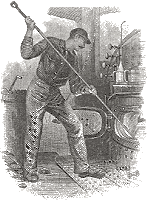 Fireman
. In the
days of steam engines, the fireman kept the boiler lit, fueled and operational
and otherwise assisted the
engineer.
In my day, it was assumed the fireman was an engineer-in-training and was to
assist the engineer. In actuality, except for taking over the controls on the
very rare occasion that an engineer had to use the head while the train was
moving, none of the firemen I rode with seemed to do much of anything. And even
though they were guaranteed a window seat, some firemen didn’t even wave to the
kids at grade crossings. I mean, is nothing sacred?
Gandy dancer. An
old railroad term for maintenance-of-way
workers: the men who put down the trackbed and track, and made sure it stayed
there. The origin of the term is not certain.
 |
| Back up |
Hand signals. Nowadays,
trainmen use hand-held
radios. When I worked
the
PC,
crews weren't provided with radios—we used
hand signals, a language of its own. There was a large array of hand signals conveying a wide range
of information and instructions. A
conductor
might signal a
brakeman to “uncouple
the 4th car and close the air valve.” Or the brakeman on one train might signal
a train passing in the opposite direction, “The brakes are locked on the 32nd
car from the rear end of your train and the wheels are sliding.”
But there were four basic hand signals: “go
forward,” an up and down waving motion in front of your body; “back up,” a
circular motion of your arm and hand; “slow down,” an arm raised up and held
steady; and “stop,” either a wave from side to side across your body or both
arms out to your sides waving up and down, like in the exercise called a
jumping jack—except you don’t jump.
 |
Proceed
forward |
At night, we used railroad
lanterns—basically a flashlight with a large reflector and a semi-circular
handle—or, if signaling over a considerable distance, we used what we called a fusee
(few-ZEE). Most folks call it a flare; they are the fiercely
burning chemical-packed tubes producing a bright red flame and are commonly used by highway patrol officers as temporary
traffic warning devices.
If you were far from the engine, you made
your signals large, slow and obvious, especially at night. If you were close to
the engine in the daytime, signals might be made with just short, simple
movements of one hand.
 |
| Stop |
The
up and down wave meaning “go forward” also, depending on circumstances, could
mean “your train looks good” (as a safety check to a passing train), “the track
is clear ahead” and “highball” (proceed at your maximum safe speed). The term
“highball” referred to an early railroad semaphore signaling device that used
an iron ball. When the ball was in its highest position, it meant that the
track ahead was clear and the train could proceed at maximum safe speed.
One thing the timetable manual made
clear: any unusual frantic waving motion by someone next to the track meant
STOP. Frantic waving saved a kid’s life one time—but that’s another story.
 |
A rusty hopper in PC green.
Heh-heh! This picture is from a
finely detailed model railroad. |
Hopper car. An
open-top type of
rolling stock that
is used for carrying loose bulk materials; it has opening doors on the underside
or on the sides to discharge its cargo.
Hotel. The
railroad hotel in Cleveland was a
dingy old ramshackle two-story dormitory with food service, showers and a TV
lounge. It was located in a rust- and soot-encrusted industrial area at the
edge of the PC’s Cleveland
yard. The rooms were tiny, just big enough to hold a single bed and a
straight-back chair; a grimy window looked out on who knows what. On the other
hand, the accommodations were free and the sheets were clean.
The food was
hearty and cheap. I once bought a T-bone steak dinner for $2.25, a small
fraction of the price of a restaurant steak even in those days. Usually though, no
matter what time of day I got in, I ordered breakfast: eggs over easy and hash-browned
potatoes. And when they woke me up 6½ hours later to crew a train back to Toledo,
I ate breakfast again. It was at the railroad hotel that a conductor I’d crewed with insisted that I drop my eggs on
top of my hash browns and then pestered me to sprinkle them with Tabasco; I’ve
been eating them that way ever since.
 |
link visible on the cen-
ter beam; here the pin is
down, in the locked
position.
|
Knuckle or Janney
coupler. The standard device for coupling railroad cars together in the
U.S.
The knuckle is efficient and semi-automatic; a locking “pin” has to be operated
manually to uncouple. However, they require the significant force of a
slowly-moving train to activate the coupling mechanism, and a
brakeman or
conductor must direct and observe the hook-up to assure that the
pin has dropped into the locking position, and then to manually connect the air
brake hoses. To uncouple, a trainman must operate a lever which raises the pin
from the locked position. The pin is actually a solid iron bar about an
inch-and-a-half thick and foot long.
Main line.
In this case, the 120 miles
of Penn Central tracks between Toledo,
Ohio and Cleveland,
Ohio. More specifically, that part of the right-of-way that was outside the
boundary of a major railroad yard. The
section between Toledo and Cleveland
was double-tracked, meaning it had two parallel railroad tracks with
intermittent crossover connections;
this arrangement allowed for a significant advantage in the movement of trains.
The main line was also known as the road.
 |
Knuckles coupled;
another design of the Janney |
The
PC Toledo East Division main line ran
through the industrial areas of large and small cities and towns, but most of
the right-of-way was through suburbs, farmlands and woodlots and sometimes ran
parallel to highways, which provided me with another opportunity to pull on my
big, leather, gauntleted
work gloves
and wave to the kids in passing cars. The main line also had stretches right on
the
shore of Lake Erie,
frequently traversing bridges and causeways across rivers, inlets and small
bays; it could be quite scenic.
Main line pay. Trainmen were permanently
assigned to either the main line or the
yard. Yard work had regular shifts,
but the work was more physical. Main line workers, while
dealing with very irregular hours, enjoyed a bit more of the panache of true
railroading and, depending on circumstances, could earn more money than yard
workers. Main line trainmen on the PC were paid both an hourly rate and by a formula that took into
account the size of the consist and
the distance you traveled. In the Toledo
East Division, the maximum and usual distance was 120 miles and trains could
sometimes have over one hundred cars, though 60 to 70 cars were more common. That
mileage and the number of cars boosted your pay. The hourly rate wasn’t that much;
you earned the highest wage with long trains that did little work and moved quickly to your Division
terminus.
Maintenance-of-way.
The operational division charged with maintaining the tracks, trackbed and
related items upon which the trains moved.
 |
| PC, the Penn Central logo |
PC. See Penn
Central
Penn Central. The
railroad that resulted from the merger of the New York Central Railroad and the
Pennsylvania Railroad. It operated in the 1960s and -70s. In turn, the Penn
Central, along with several other north-eastern U.S.
railroads, was folded into Conrail. Because of its logo, the Penn Central was
also known as the PC.
 |
| Fusee (see Hand signals) |
Radios. Ha! We
didn’t have radios back then. A few of the engines had two-way radios
installed, but they were for communicating with the dispatcher in
Toledo.
When working to direct train movement,
PC
trainmen used
hand signals.
Right-of-way. 1.
The strip of land owned or otherwise controlled by the railroad along its
tracks. 2. The superior claim of one train’s movement over another train. On
the PC, the hierarchy of train
movement went first to passenger trains, then mail trains, then trains with
perishable goods (e.g., refrigerated food), then unit trains (i.e., trains with
a consist of all-alike cars and cargo, such as coal hoppers or automobile carriers, also called “auto racks”), then mixed
freight trains and, at the bottom of the list, trains with a consist of empty
cars and finally, trains like TR-12 (see Work).
Road. Often, the road. Another term for the main line, specifically a term
differentiating the main line from the yard.
I worked on the road.
Rolling stock. Any
wheeled equipment that could move along the railroad tracks. This would include
locomotive engines, freight or passenger cars, cabooses, maintenance-of-way vehicles, etc.
Siding. A short
section of railroad track connected at each end by switches to a main track.
Slow orders. Written or printed orders always handed
directly to the conductor and engineer specifying provisional speed
restrictions for particular blocks of
track, usually where gandy dancers
were working or some other exceptional and temporary hazard existed.
Spur. A side
track that connects with a main track via a switch.
 |
A switch, set for the track
to the right |
Switch. An
arrangement of movable rails that allows a train to transfer between adjacent
tracks.
Switch run. A
regularly scheduled local train that works a spur line, factory yard or other
routine assignment, mostly on feeder lines off the main line.
Territory. The
geographic region governed by a specific operational division of the railroad,
including all of the main line and spur, rights-of-way, trackage, block signals, buildings,
and other appurtenances therein. The Toledo
East Division was a territory.
Toledo East Division. I worked in the PC’s Toledo East Division, which
extended from Toledo, Ohio
to Cleveland, Ohio
and included the main line between the two cities as well as a number of spur
lines throughout northwestern Ohio
and southeastern Michigan. The
Toledo East Division was just one territory along one of the PC’s main lines, this one extending from
Chicago, Illinois
to Buffalo, New York.
 |
| Truck |
Truck. The wheels
and supportive undercarriage on which railroad cars move.
Union.
The railroad workers’ union; I don’t remember which union it was. As a
summertime vacation-relief employee, I never worked long enough to qualify to
join; even so, membership dues were deducted from my wages. Still, the rules of
the union contract with the Penn Central
strictly governed my specific job responsibilities and working conditions.
 |
Air brake hoses are joined here
in a loop below the knuckles.
A brakeman or conductor
had to manually join the hose
ends after the cars were
coupled. |
Work. A
main line term for having to stop at a
siding,
spur or local
yard to
pick up and/or drop off freight cars for/from your train. It may sound simple,
but it was the slow, cumbersome, frequent and basic physical grunt work of main
line trains—and it was mostly performed by the brakemen. Work involved walking
long distances rapidly (running was strictly prohibited by safety rules),
climbing on and off moving train cars, operating manual
switches, coupling and uncoupling freight cars, manually connecting
air brake hoses, setting manual brakes on freight cars, directing the engineer with
hand signals and other duties. It was a rare and happy occasion when your train
went the whole distance without work.
 |
The brake hose couplings are on the
right. I had to learn a special
two-handed twist grip to join the
coupling. |
A few trains had so much work—especially one late-night clean-up train always designated TR-12—that the crew
could reach the 16-hour work limit and still not have arrived at the
Cleveland
yard. It would be put into a siding and have to wait until a relief crew could be
driven out from Toledo. No one liked to be detailed to TR-12, including me. It not only was assigned a lot
of work, it also was forced to yield the
right-of-way
to every other train, making for repeated, lengthy delays.
 |
| Common yard limit designator |
Yard. An area
where railroad trains are made up and cars are switched, stored, and serviced
on tracks and sidings.
Yard day. Wages
equivalent to working eight hours in the yard.
Yard limit. The
official boundary of a railroad yard.
The rules and practices of train movement and trainmen’s duties changed at the
yard limit: yard rules versus road
rules.
And now, how I survived a train derailment...
(Underlined words or phrases indicate
the first use of a
term in the glossary.)
I was 19 that summer and had just finished my freshman year
in college. I was working the
extra board as a
main line brakeman
on the
Penn Central, assigned to the
Toledo East Division.
Early in July, some horrendous thunderstorms had muscled
through the Great Lakes region. Throughout northern Ohio,
especially along the southern shores of Lake Erie, there
was considerable flooding and wind damage. The PC main line ran along that
southern shore, sometimes along the shoreline itself.
Notably problematic for the Penn Central and the trainmen
that worked it, was that the block signal system along the entire main
line had been damaged by the storm—all the signals were black. Often,
while operating trains on the main line, a black signal to your rear was good,
indicating no trains were approaching from that direction with which your train
might have to contend for right-of-way. But that was not the case this
time.
Even under the best conditions, moving, manipulating and
managing mile-long trains weighing thousands of tons and put together from
dozens upon dozens of massive segments of rolling stock was a dangerous
way to make a living. Without the block signals, it felt very much like trying
to jaywalk a busy highway while wearing a blindfold; it was out and out scary.
There were slow orders covering the entire Division’s
main line; even tracks that normally had a 70 mile-per-hour speed limit were now
restricted to a maximum speed of 35 m.p.h.
for all trains. As one might imagine, this really gummed-up the flow of train
traffic.
First time I was called in after the storm, they couldn't
even get us on our train and out of the yard within the required (union
rules) 60 minutes, so I got paid a yard day after only two hours on duty—spent
sitting on a bench in a locker room.
Next time I'm called in, they got us past the yard limit,
though it still took more than an hour, so I earned a yard day plus my regular main
line pay. But the block signals were still out and the slow orders remained
in effect. All the movement instructions came via radio (though not all
engines had radios yet) and via the phone boxes—actually small sheds—that were
located every few miles along the right-of-way. We spent a lot of time standing
still.
After about 12 hours, we finally made the Cleveland
yard. I had a cheap but hearty meal at the railroad hotel and signed into
a tiny room for the required eight hours of rest. Then it was another slow
crawl past all black signals on a train back home.
My next call-out was for a switch run, a train designated the Red Arrow.
I have no idea why it was called that. The name was far classier than the train
and its work, which was tending to factory and agricultural spurs
in and near several small towns in northern Ohio.
 |
Brakeman operating a switch lever.
|
Part of our work that day was a bit unusual and was related
to the storms from nearly a week before: replacing some trackbed
ballast
where flooding had left some gaps. Union rules said the train
crew
couldn't do
maintenance-of-way chores, so a crew of PC
gandy dancers
met us at the site.
In front of the Red Arrow’s engine we were pushing a couple hopper
cars loaded with the heavy gravel the PC used for ballast. The conductor
said it might be interesting to watch, so I got down to scope out the process.
The dancers placed a railroad tie across the rails just in
front of the hopper's rear truck. Then they opened the hopper's bottom
dump chute to drop some of the gravel onto the track. Coordinating with the
conductor, who'd taken charge of directing train movement, they pushed the
hopper slowly over the washed-out spots. The railroad tie, pushed along by the
truck's steel wheels and sliding on top the rails, acted as a spreader, and filled in the gaps
with the new ballast.
The dancers then did their thing, using heavy digging bars
and long-handled picks to jam the ballast in place and settle-out air pockets.
It was hard, hot, dusty work; I was glad I was watching from the shade of a nearby
tree.
After replacing the ballast, the last part of our assignment
was to pick up a piece of factory equipment in some little town I don't
remember the name of anymore.
Arriving at a short spur, we left the rest of the consist
out on the switch line (the Red Arrow was the only train that worked that line)
and took the engine across the switch. The spur, maybe a couple hundred
yards long, led right into a large wood-frame machine shed. The shed looked
like a giant 1940’s-vintage garage, with two sliding wood doors, each with a
row of windows high up. If Paul Bunyan had owned a suitably-sized Packard, this
shed would have contained it nicely.
The doors were closed and secured with a padlock; the
conductor had a key and he slid the doors open. (For all the work the other
brakeman and I did on this trip, we were about as useful as teats on a tractor
tire—but, those were the rules.)
 |
| A double-trucked, drop-center flat car, empty |
Inside the shed was an enormous machine, about the size of
two semi-trailers and mostly contained under a green-painted metal hood; I had
no inkling as to its purpose. It was already loaded and secured on an unusual
piece of rolling stock: a heavy-duty, drop-center flat car. It had double
trucks at both ends and its entire center deck was low to the tracks.
The conductor directed the engineer in coupling onto
this monstrosity. With the knuckles connected and the air hoses joined,
the conductor gave the hand signal to move out of the shed. It was an
oversize load, so we were operating under severe speed restrictions;
even so, the engineer barely idled out of the shed.
I was standing outside on the engine's catwalk with the
other brakeman. We were just watching the show and enjoying the weather.
And, just like that: THUMP! A single, solid tremor rattled
through the engine. And we weren't moving anymore.
The diesels revved for a second, and again. Then we heard
the engineer cussing loudly.
The other brakeman and I had no idea what the problem was. I
thought the thump was just us pulling slack out of the knuckles.
But the engineer came to the cab door and began yelling at us, "How fast do you
think we were going?" We couldn't figure out why he was asking us that,
and we glanced at each other, not sure what exactly it was he was referring to.
Exasperated, the engineer repeated the question, this time adding a few
choice expletives.
I finally said "Uh, if you mean just now, then maybe one or two miles per
hour."
Then he made the other brakeman estimate it and he said,
"Couldn't been more than two miles an hour."
"Okay, remember that!" the engineer snarled at us.
He then warned the fireman to keep his mouth shut,
and he went back to his seat, sat down, crossed his arms over his chest and
glared at the engine controls, silently fuming.
Something important had happened, but I hadn't a clue as to
what it was.
The conductor, who is actually the boss on a train, had been
walking around looking beneath the engine. Finally, he climbed up on the engine,
squeezed past me and the other brakeman and went into the cab to talk to the
engineer. We’d moved to the engine’s cabin door over on the fireman’s side of
the cab when the conductor went inside. The conductor had his back to us and
we couldn’t hear what he was saying. The engineer gave a couple grudging nods,
then he snapped at the conductor, "I'm not sayin' nothin’ else until I
talk to my union rep."
The other brakeman and I still didn't know what the heck was
going on. It was probably five minutes before the conductor came over and
explained to us why we weren't moving anymore: we were on the ground
(railroad-speak for being derailed); the engine wasn't on the rails anymore!
I couldn't believe it. That thump was us being derailed?
 |
| Not hardly. |
To me, a derailment meant big-time smash-ups, spilled cargo
and bodily injury, not a minor bump—especially since the senior crew members
were so cranked up about it. I thought we got off pretty light for derailing a
diesel locomotive. Heck, I’d been standing while it happened and never even came close
to losing my balance (of course, I'd been following one of the cardinal rules for
working on a moving train: always have ahold of something solidly attached to
the train. In this case, it was the safety rail alongside the catwalk).
Later, I learned from the conductor that the engineer was reacting
to the anticipated incident hearing that would likely result from the
grounding. The engineer fully expected that company management would rake him
over the coals for the accident. On the PC, according to employee lore, there
was no greater sin than to put your train on the ground and there was no
greater catchall than "employee error." The engineer was so concerned
about the hearing that he’d refused to even admit that we were on the ground, even
refused to tell the rest of the crew what he knew had happened. Nor would the
fireman say anything, after the engineer had warned him not to talk to
anybody about it. Incident hearings could result in severe disciplinary action, up to
and including being fired.
 |
Typical switch run engine. The head brakeman
sat in a center seat, enjoying a "view" of the
forward bulkhead; it made for a tedious ride.
|
I climbed down and looked under the engine but no rails were
visible; everything was hidden by the undercarriage which was pressed into the muddy
ballast. The recent storms had left many places still saturated.
Fortunately, the machine shed was right across the street
from a little motel and diner; the conductor went over there to call it in.
Meanwhile, the engineer'd been sitting there in a giant pout.
After a while he started muttering, "They're not gonna' pin this on me,
damit! This wasn't my fault," over and over again.
The conductor came back after about a half hour and told us
that things were still a mess throughout the territory because of the storm. They couldn't get a crane out there until the next day, so we were there for
the night. He also explained to me and the other brakeman that management
seldom found equipment failure as a cause for incidents, and tended to put the
blame on crews, which was why the engineer was acting so squirrelly. He even
warned us to talk to a union rep because we might be at risk. I was
dumbfounded! How in the heck was I responsible for whatever it is that had
happened? (In fact, I was long gone back to college before anything ever came
of it, if it ever did.)
So, unprepared for an overnight, and filthy and sweaty (more
from the heat of the day and the dust from the new ballast than from any real
work), I crossed the street with the rest of the crew to the little motel. The
conductor signed us in, on the railroad's dime, though we had to pay for our
own meals (hey, union contract).
About 9 the next morning, the same gandy dancers showed up
and finally, a couple hours later, two semi-tractor-mounted 30-ton cranes
pulled up on the street next to the tracks. The plan was for the cranes to lift
the engine, the dancers would repair the track, and the cranes would set the
engine back on the rails.
 |
| 70-ton railcar-mounted crane |
The PC’s problem was that all the heavyweight
railcar-mounted cranes were busy with storm damage elsewhere; the best they could
get were these two 30-ton mobile lifters. Unfortunately, we had a 70-ton
locomotive engine.
Well, the dancer boss got to head-scratching with a
supervisor muckety-muck who had come out from Cleveland and they came up with a
new plan: they'll have the cranes lift the engine one end at a time, fix the
track under each end in turn, and set the engine down on each repaired portion.
Downside is, the job will take about three times longer than it would have with
a heavier crane. On the other hand, I'm getting paid to sit around and watch a
really interesting project and, except for the lack of a toothbrush, razor, deodorant
and clean clothes, I'm at peace with the world.
 |
| 30-ton mobile crane |
When they first lifted one end of the locomotive, it's discovered
that one of the rails simply fractured under the engine. Best guess was that the
relatively old ties and trackbed on the machine shed spur were further weakened by all the
rain (we'd motored through some major puddles at several places), the spikes
had let go, and the rail split under the un-supported stress. I was wondering
how the bosses would blame that on crew error.
We were back on the rails by about 8 that evening. The
supervisor from Cleveland decided
not to move the heavy factory machine over the track until the entire spur could
be inspected. We pushed the big flatcar back into the shed, and the conductor
closed and locked the doors.
Three hours later, with the main line block signals back in
working order, we were in the Toledo
yard and my assignment with the Red Arrow was finished.
And I'd survived a train derailment.
 |
| PC main line freight passing a switch tower |
But not without injury.
While watching the repairs, I had
moved well away from the track so as not to be in the way. Several days later I
discovered I'd wandered into some poison ivy—had it all over my right arm.
Speaking of injuries, there was the time I fell off a caboose as the train was
picking up speed on the main line—me square on my keister next to the track and
the conductor yelling from the back platform of the rapidly departing caboose,
“C’mon! Run! You can make it!”
But that's another story.
*


 I got to see my first bullet wound that
night, down in ER. And I learned why the ER entrance was kept locked with an armed security guard at the door. The other orderly on shift, a more
experienced guy, showed me the pock marks on the wall, repaired bullet holes
from a street gang battle that, two years earlier, had spilled over into the treatment
room where one of the wounded gang members had been brought by his buddies.
I got to see my first bullet wound that
night, down in ER. And I learned why the ER entrance was kept locked with an armed security guard at the door. The other orderly on shift, a more
experienced guy, showed me the pock marks on the wall, repaired bullet holes
from a street gang battle that, two years earlier, had spilled over into the treatment
room where one of the wounded gang members had been brought by his buddies.


 I'm just checking in here to mention that I am more likely to make entries at Uncle Genie's Other Blog as my life, in general, has become more static since I gave up the travel trailer, snow-birding, and driving altogether. Not quite as much of the day-to-day worthy of mention now that I am an apartment dweller.


 My MS Bookshelf American Heritage Dictionary
(1992) does not include "equanimous." While surprised, I handled the revelation
with equanimity.
My MS Bookshelf American Heritage Dictionary
(1992) does not include "equanimous." While surprised, I handled the revelation
with equanimity.


 Fireman. In the
days of steam engines, the fireman kept the boiler lit, fueled and operational
and otherwise assisted the engineer.
In my day, it was assumed the fireman was an engineer-in-training and was to
assist the engineer. In actuality, except for taking over the controls on the
very rare occasion that an engineer had to use the head while the train was
moving, none of the firemen I rode with seemed to do much of anything. And even
though they were guaranteed a window seat, some firemen didn’t even wave to the
kids at grade crossings. I mean, is nothing sacred?
Fireman. In the
days of steam engines, the fireman kept the boiler lit, fueled and operational
and otherwise assisted the engineer.
In my day, it was assumed the fireman was an engineer-in-training and was to
assist the engineer. In actuality, except for taking over the controls on the
very rare occasion that an engineer had to use the head while the train was
moving, none of the firemen I rode with seemed to do much of anything. And even
though they were guaranteed a window seat, some firemen didn’t even wave to the
kids at grade crossings. I mean, is nothing sacred?


